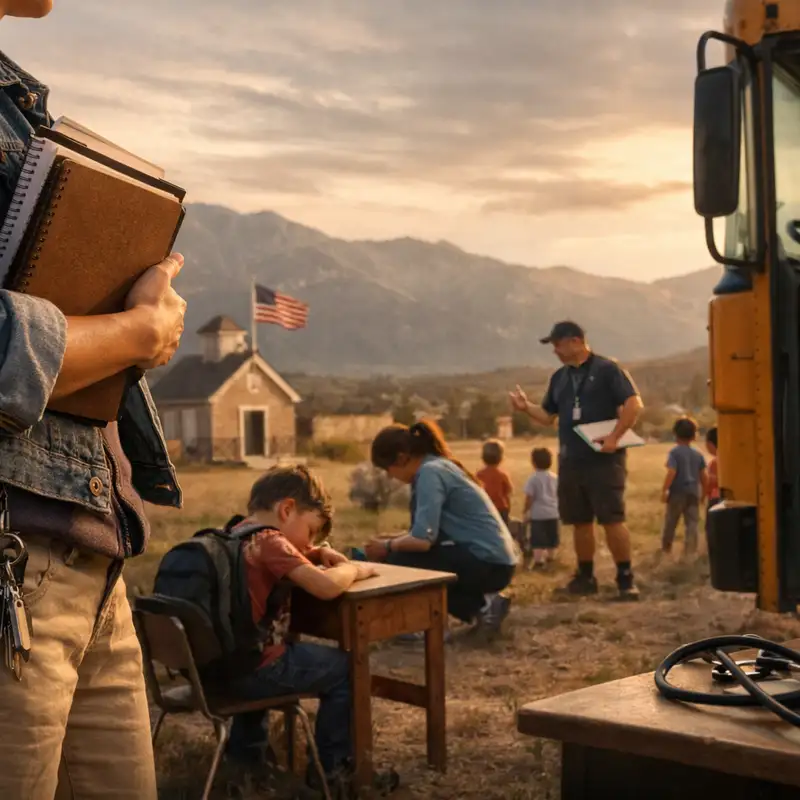
The Hidden Reality of Rural Classrooms (And Why Educators Are Burning Out)
Hey friends.
Welcome back to Chitty Chats with Stacy.
Love, love, love the energy y'all
are giving me and all the things
that are happening with what's
happening here at CHI Chats.
So I. Mentioned last week that I'm
interested in talking about rural America,
so I wanna have a little conversation.
I had the wonderful opportunity of
flying to a small town in Montana
on a very small plane to hang out a
couple weeks ago with some educators.
And then a few weeks before that I
was in a very small town in Colorado
that you can't fly to, you have to
drive to once you get to Colorado.
And I wanna just speak to that.
So rural America for those of you that
don't know, I grew up in a small town in
Wyoming and spent most of my childhood
really understanding that once you leave
this small town in Wyoming, you're not
gonna see another town for two hours.
And that's probably bizarre for some
of you who are listening because
you might live in a place where,
you know, a town can, you can have
lots of towns in two hours, but in
Wyoming, that's just not how it is.
So when I started.
Doing school-based mental health work.
I was in a lot of little towns all over
the state of Montana, and I started to
see and realize just there's, so it's
like the two, two sides to the same coin.
There's so much.
Cool stuff that can happen in a small
town in that you know everybody, you've
got some safety and connection, maybe
you've got generations of people there.
And the flip side of that is you know
everybody and you've got some connections.
There might not be safety and
there might be less resources.
And so today I'm gonna specifically
talk about rural education and my
experiences with rural educators.
And so if you're a
parent, a colleague, care.
Caregiver listening, and you live in
a rural town, you can probably relate
to some of this because you're, maybe
you're looking for services for your kid
or you're advocating for your student,
and it's a little bit more difficult.
If you are an educator and you
don't live in a rural space, I
encourage you to listen purely
because rural, pretty fascinating.
I work with lots of educators
in rural America and many
of them wear multiple hats.
They're the athletic to.
Rector and the math teacher and
the bus driver and a sub if needed.
And I work in some schools where you might
just have one or two kids per grade or
maybe one kid in one grade, or you have
a K 12 school that is maybe 50 kids.
And so what happens when you are
trying to implement trauma, restorative
trauma, sensitive restorative
practices in these small town?
In these small areas is that educators
have to be armed with even more
resources because there's only so
many people who can do the things.
We can't just have a
extra additional para.
We can't have, we can't send this kid
to the school counselor because the
school counselor might only be there
one day a week because the school
counselor is shared in seven different
schools across four hours of drive time.
It's important to know that there's
just different challenges that show
up, and part of the reason I'm so
passionate about rural education is
because I think that a lot of people
don't understand it, and I want to.
Always arm people with really
good resources when you are,
when you're in the classroom and
you're working with tough kids.
And so a few things that I want to
just impart upon our listeners today
is one, the value of understanding
development, both physical development,
brain development, emotional development
is critical if you're gonna work
with children just in general.
It's more critical I think, when.
You're working in a rural setting
because you don't have other
professionals who are gonna come
in and help you understand that.
You may not have an occupational
therapist that's gonna talk to you
about sensory processing disorders.
You may not have a school psychologist
that's available to talk to you
about medication or A DHD and
or a diagnosis of some sort.
You may not have people who
can help you learn these
things, and so I think it's so.
Important to really understand the
way brains develop and the order.
The brain is, it's an animal
that's always developing, right?
But it's integrating as we go and
kids are creating neural pathways.
And one of the things that we're seeing
significantly in children these days
is that they are not playing as much.
One of my rural schools is only
doing one 15 minute recess.
A day for elementary kids.
That's it.
15 minutes a day for elementary kids,
and they want higher test scores.
They're wondering why kids
aren't learning and play, being
outside moving your bodies.
That is how the brain works.
That's how the brain works more.
And with kids these days, we
have to pay even more attention
to that because so many of our
kids are not moving their bodies.
They get a screen.
At 1-year-old and they're on a screen and
they're not picking a block up and putting
in a block, they're not rolling around.
They're not crawling, they're not
pulling dishes out of cupboards
and banging them on the floor,
which may be annoying as a parent.
And it's critical for development.
It's critical for kids understanding
exploration and observation and problem
solving and all these things that happen
later that we need for development.
So if you are a rural educator, the one
thing, if you have just a little bit of
time, I would take a deep dive into just
understanding how the brain develops.
Find some information on, early childhood.
Get in there.
Even if you are a high school teacher,
it is critical to understand this because
we are seeing delayed development.
We now have.
Today it's 2026.
Our COVID babies are now starting school
and they're starting at five years old.
And we know that they're starting
with delayed development.
They are not the same five year
olds that we saw five years ago.
They're starting and their development
is more of a two to 3-year-old, a three
to 4-year-old, a four to 5-year-old.
So it's really critical to understand
that, and I really love, zero to three.
You spell it out.
Z-E-R-O-T-O-T-H-R-E e.org.
It's an early childhood
educational website.
They've got a lot of domains.
What does a cognitive domain
look like at various ages?
Physical domain, emotional domain.
Spend some time really
understanding child development
because the more you understand.
And child development and the way kids
are wired these days, these are not the
same kids as the seventies, eighties,
nineties, two thousands, 2000 tens.
These are new kids.
This is totally different way
of raising them, of approaching
them, of responding to them.
Their brains are wired completely
differently because of this
huge technology push, and we
have to stop denying that.
That's true.
And so spend some time learning
about development because what
I want you to start doing.
Instead of thinking about a diagnosis in a
child, I want you to start thinking about
where are they at developmentally and
how do we close their developmental gaps?
The coolest part about working in a
rural school is that if you have a
kid who's a fifth grader and they are
developmentally at a first grade level,
you could work it out in your school
for that fifth grader to go hang out
with the first graders and read to.
Them.
You can put them in a situation where
they can feel confident and they can
feel good about what they're doing,
and they can practice with people
who are at the same level as them.
If you are in a high school, in a rural
community and you have kids who are
acting like middle schoolers, you can
have them sponsor middle school, pe, and.
You can have him do some student
teaching in middle school PE and
you can talk to the PE teacher
and say, Hey, I've got this kid.
He's got to close some gaps and
we need him to hang out with
middle schoolers and practice some
of this middle school behavior.
There are such cool things that you can
do in a rural community that you can do
in a community that's a big school, and
so really get into brain development.
I have nerded out on it
for the last several tech.
Aids.
I love it.
It has completely changed
the way I see the world.
So that's one thing.
The second thing that I really want
you to think about is stress cycles.
When a stress cycle happens,
typically what happens is
an event occurs, somebody has some
sort of activating response, fight,
flight, freeze, fawn, and then the event
is over and our body needs a way to.
Normalize whatever just happened
or process, whatever just happened.
But what we often do is we take
these little off ramps where
we really avoid the feeling.
We work out.
We do all sorts of things.
And so in rural communities,
in rural schools, we gotta have
a. Way for kids to process big
events that is safe for everyone.
And so I want you to start thinking in
your school districts, in your classrooms,
how can you create cultures of regulation
where people can close their stress cycle?
Where kids can learn how to jump
if they're upset or cry if they're
sad, or write a note if they need
to repair and they have something
on their heart or whatever.
Like it doesn't mean they just get.
To get away with whatever they want.
Doesn't mean we don't have
an expectation for them.
It means that we're gonna
close a stress cycle.
And so it's gonna look different in
a rural community than it might in
a regular school because you may not
have resources like a regulation room.
You may not have resources like a room
that can, you know, or extra people
who can come and tap in or tap out.
So I just think.
I want you to get creative and
start thinking about how do
you close that stress cycle.
And then the last thought I'm gonna
leave you today with is you, I want
you to start getting, and this is
for any educator that's listening
specifically in rural communities.
I know that.
Many of you have been living and
teaching in your community for decades.
Your grandma taught, your
grandpa taught, your mom taught,
your dad taught your teaching.
You have got generations of education
rolling and flowing through your blood.
And that might mean that your nervous
system is wired in a way that.
May or may not be helpful
for your current situation.
So I really want you to think
about your own nervous system.
Like what is stressing you out?
What is it that you are?
Maybe you're, you need to
close your own stress cycle.
Maybe you've got a lot of things
on your brain and your heart, your
mind that you're thinking about.
I think it's critical for you
to just really get curious
about your own nervous system.
So I, that's it, that's all I
wanna say about rural America.
I'm sure it will come up.
Drop me a question, send me, send
me an email, drop me a comment.
What?
What else can I help you with?
What else in rural America
are you struggling with?
I think there's a lot that we
can talk about, but I want it to
be useful and helpful for you.
Oh.
Oh, actually the fourth thing.
Include the community.
Include the community.
Do a parent night and talk to
parents about restorative circles.
Talk to parents about trauma informed
and trauma restorative practices,
trauma sensitive practices.
Talk to parents about brain development.
Help parents know what you're doing.
Send out a newsletter and put a
little blurb in it so the community
also knows what you're doing.
Many times in rural America, you.
Are up against community.
Man, we've got some Judge mc judger
attends in the community that also don't
have anything to do with education.
They haven't taught, they
haven't been in a classroom.
They don't even work with kids.
But boy, howdy.
They got some opinions.
And so educating your community
can be a very helpful piece.
So brain development.
Closing your stress cycle, getting
curious about your own nervous
system and including the community.
All right friends.
I will see you again or chat
with you again next week.
Take care of you.
Bye.
Creators and Guests